In case you missed President Obama's congress.... here is the full transcript:
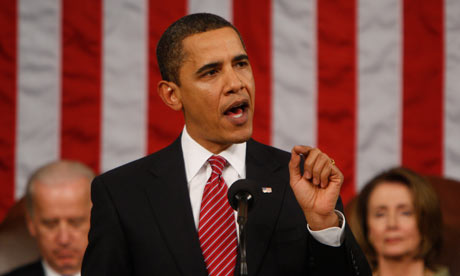
Madame Speaker, Vice President Biden, members of Congress, and the American people:
When I spoke here last winter, this nation was facing the worst economic crisis since the Great Depression. We were losing an average of 700,000 jobs per month, credit was frozen, and our financial system was on the verge of collapse.
As any American who is still looking for work or a way to pay their bills will tell you, we are by no means out of the woods. A full and vibrant recovery is still many months away. And I will not let up until those Americans who seek jobs can find them.
Until -- until those -- until those businesses that seek capital and credit can thrive. Until all responsible homeowners can stay in their homes.
That it our ultimate goal. But thanks to the bold and decisive action we've taken since January, I can stand here with confidence and say that we have pulled this economy back from the brink.
Now, I want to thank the members of this body for your efforts and your support in these last several months, and especially those who have taken the difficult votes that have put us on the path to recovery.
I also want to thank the American people for their patience and resolve during this trying time for our nation.
But we did not come here just to clean up crises. We came here to build a future. So...
So tonight, I return to speak to all of you about an issue that is central to that future, and that is the issue of health care.
I am not the first president to take up this cause, but I am determined to be the last.
It has now been nearly a century since Theodore Roosevelt first called for health care reform.
And ever since, nearly every president and Congress, whether Democrat or Republican, has attempted to meet this challenge in some way. A bill for comprehensive health reform was first introduced by John Dingell, Sr., in 1943. Sixty-five years later, his son continues to introduce that same bill at the beginning of each session.
Our collective failure to meet this challenge year after year, decade after decade, has led us to the breaking point. Everyone understands the extraordinary hardships that are placed on the uninsured who live every day just one accident or illness away from bankruptcy. These are not primarily people on welfare. These are middle class Americans. Some can't get insurance on the job. Others are self-employed and can't afford it since buying insurance on your own costs you three times as much as the coverage you get from your employer.
Many other Americans who are willing and able to pay are still denied insurance due to previous illnesses or conditions that insurance companies decide are too risky or too expensive to cover.
We are the only democracy, the only advanced democracy on Earth, the only wealthy nation that allows such hardship for millions of its people.
There are now more than 30 million American citizens who cannot get coverage. In just a two-year period, one in every three Americans goes without health care coverage at some point. And every day, 14,000 Americans lose their coverage.
In other words, it can happen to anyone.
But the problem that plagues the health care system is not just a problem for the uninsured. Those who do have insurance have never had less security and stability than they do today.
More and more Americans worry that if you move, lose your job or change your job, you'll lose your health insurance, too. More and more Americans pay their premiums, only to discover that their insurance company has dropped their coverage when they get sick, or won't pay the full cost of care. It happens every day.
One man from Illinois lost his coverage in the middle of chemotherapy because his insurer found that he hadn't reported gallstones that he didn't even know about. They delayed his treatment, and he died because of it.
Another woman, from Texas, was about to get a double mastectomy when her insurance company canceled her policy because she forgot to declare a case of acne. By the time she had her insurance reinstated, her breast cancer had more than doubled in size.
That is heartbreaking, it is wrong, and no one should be treated that way in the United States of America.
Then there's the problem of rising costs. We spend one- and-a-half times more per person on health care than any other country, but we aren't any healthier for it. This is one of the reasons that insurance premiums have gone up three times faster than wages.
It's why so many employers, especially small businesses, are forcing their employers -- employees to pay more for insurance, or are dropping their coverage entirely.
It's why so many aspiring entrepreneurs cannot afford to open a business in the first place, and why American businesses that compete internationally, like our automakers, are at a huge disadvantage.
And it's why those of us with health insurance are also paying a hidden and growing tax for those without it, about $1,000 per year that pays for somebody else's emergency room and charitable care.
Finally, our health care system is placing an unsustainable burden on taxpayers. When health care costs grow at the rate they have, it puts greater pressure on programs like Medicare and Medicaid.
If we do nothing to slow these skyrocketing costs, we will eventually be spending more on Medicare and Medicaid than every other government program combined.
Put simply, our health care problem is our deficit problem. Nothing else even comes close.
Nothing else.
Now, these are the facts. Nobody disputes them. We know we must reform this system. The question is how. Now, there are those on the left who believe that the only way to fix the system is through a single-payer system like Canada's, where we would -- where we would severely restrict the private insurance market and have the government provide coverage for everybody.
On the right, there are those who argue that we should end employer-based systems and leave individuals to buy health insurance on their own.
I have said -- I have to say that there are arguments to be made for both these approaches. But either one would represent a radical shift that would disrupt the health care most people currently have. Since health care represents one-sixth of our economy, I believe it makes more sense to build on what works and fix what doesn't, rather than try to build an entirely new system from scratch.
And that is precisely what those of you in Congress have tried to do over the several -- past several months. During that time, we've seen Washington at its best and at its worst. We've seen many in this chamber work tirelessly for the better part of this year to offer thoughtful ideas about how to achieve reform. Of the five committees asked to develop bills, four have completed their work and the Senate Finance Committee announced today that it will move forward next week.
That has never happened before.
Our overall efforts have been supported by an unprecedented coalition of doctors and nurses, hospitals, seniors' groups, and even drug companies -- many of whom opposed reform in the past.
And there is agreement in this chamber on about 80 percent of what needs to be done, putting us closer to the goal of reform than we have ever been.
But what we've also seen in these last months is the same partisan spectacle that only hardens the disdain many Americans have towards their own government. Instead of honest debate, we've seen scare tactics. Some have dug into unyielding ideological camps that offer no hope of compromise. Too many have used this as an opportunity to score short-term political points, even if it robs the country of our opportunity to solve a long-term challenge. And out of this blizzard of charges and counter-charges, confusion has reigned.
Well, the time for bickering is over. The time for games has passed.
Now is the season for action. Now is when we must bring the best ideas of both parties together and show the American people that we can still do what we were sent here to do.
Now's the time to deliver on health care.
Now's the time to deliver on health care.
The plan I'm announcing tonight would meet three basic goals.
It will provide more security and stability to those who have health insurance. It will provide insurance for those who don't. And it will slow the growth of health care costs for our families, our businesses, and our government.
It's a plan that asks everyone to take responsibility for meeting this challenge -- not just government, not just insurance companies, but everybody, including employers and individuals.
And it's a plan that incorporates ideas from senators and congressmen; from Democrats and Republicans, and yes, from some of my opponents in both the primary and general election.
Here are the details that every American needs to know about this plan.
First, if you are among the hundreds of millions of Americans who already have health insurance through your job, or Medicare, or Medicaid, or the V.A., nothing in this plan will require you or your employer to change the coverage or the doctor you have.
Let me -- let me repeat this: nothing in our plan requires you to change what you have.
What this plan will do is make the insurance you have work better for you. Under this plan, it will be against the law for insurance companies to deny you coverage because of a preexisting condition.
As soon as I sign this bill, it will be against the law for insurance companies to drop your coverage when you get sick or water it down when you need it the most.
They will no longer be able to place some arbitrary cap on the amount of coverage you can receive in a given year or in a lifetime.
We will place a limit on how much you can be charged for out-of- pocket expenses, because in the United States of America, no one should go broke because they get sick.
And insurance companies will be required to cover, with no extra charge, routine checkups and preventive care, like mammograms and colonoscopies.
Because there's no reason we shouldn't be catching diseases like breast cancer and colon cancer before they get worse.
That makes sense. It saves money, and it saves lives.
That's what Americans who have health insurance can expect from this plan: more security and more stability.
Now, if you're one of the tens of millions of Americans who don't currently have health insurance, the second part of this plan will finally offer you quality, affordable choices. If you...
... if you lose your job or you change your job, you'll be able to get coverage. If you strike out on your own and start a small business, you'll be able to get coverage. We'll do this by creating a new insurance exchange, a marketplace where individuals and small businesses will be able to shop for health insurance at competitive prices.
Insurance companies will have an incentive to participate in this exchange because it lets them compete for millions of new customers. As one big group, these customers will have greater leverage to bargain with the insurance companies for better prices and quality coverage. This is how large companies and government employees get affordable insurance. It's how everyone in this Congress gets affordable insurance. And it's time to give every American the same opportunity that we give ourselves.
Now, for those individuals and small businesses who still can't afford the lower-priced insurance available in the exchange, we'll provide tax credits, the size of which will be based on your need.
And all insurance companies that want access to this new marketplace will have to abide by the consumer protections I already mentioned.
This exchange will take effect in four years, which will give us time to do it right. In the meantime, for those Americans who can't get insurance today because they have preexisting medical conditions, we will immediately offer low-cost coverage that will protect you against financial ruin if you become seriously ill.
This was a good idea when Senator John McCain proposed it in the campaign; it's a good idea now, and we should all embrace it.
Now, even if we provide these affordable options, there may be those, and especially the young and the healthy, who still want to take the risk and go without coverage. There may still be companies that refuse to do right by their workers by giving them coverage.
The problem is, such irresponsible behavior costs all the rest of us money. If there are affordable options and people still don't sign up for health insurance, it means we pay for these people's expensive emergency room visits.
If some businesses don't provide workers health care, it forces the rest of us to pick up the tab when their workers get sick, and gives those businesses an unfair advantage over their competitors.
And unless everybody does their part, many of the insurance reforms we seek, especially requiring insurance companies to cover preexisting conditions, just can't be achieved.
That's why under my plan, individuals will be required to carry basic health insurance -- just as most states require you to carry auto insurance.
Likewise -- likewise, businesses will be required to either offer their workers health care, or chip in to help cover the cost of their workers.
There will be a hardship waiver for those individuals who still can't afford coverage, and 95 percent of all small businesses, because of their size and narrow profit margin, would be exempt from these requirements.
But...
But we can't have large businesses and individuals who can afford coverage game the system by avoiding responsibility to themselves or their employees.
Improving our health care system only works if everybody does their part. And while there remains some significant details to be ironed out, I believe...
(LAUGHTER)
... I believe a broad consensus exists for the aspects of the plan I just outlined: consumer protections for those with insurance; an exchange that allows individuals and small businesses to purchase affordable coverage; and a requirement that people who can afford insurance get insurance.
And I have no doubt that these reforms would greatly benefit Americans from all walks of life, as well as the economy as a whole.
Still, given all the misinformation that's been spread over the past few months, I realize -- I realize that many Americans have grown nervous about reform. So tonight, I want to address some of the key controversies that are still out there.
Some of people's concerns have grown out of bogus claims spread by those whose only agenda is to kill reform at any cost. The best example is the claim, made not just by radio and cable talk show hosts, but by prominent politicians that we plan to set up panels of bureaucrats with the power to kill off senior citizens.
Now, such a charge would be laughable if it weren't so cynical and irresponsible. It is a lie plain and simple.
Now...
Now, there are also those who claim that our reform efforts would insure illegal immigrants. This, too, is false. The reforms -- the reforms I'm proposing would not apply to those who are here illegally.
(UNKNOWN): That's a lie.
(AUDIENCE BOOING) (ph)
That's not true.
And one more misunderstanding I want to clear up: under our plan, no federal dollars will be used to fund abortions, and federal conscience laws will remain in place.
Now, my health care proposal has also been attacked by some who oppose reform as a "government takeover" of the entire health care system.
Now, as proof, critics point to a provision in our plan that allows the uninsured and small businesses to choose a publicly- sponsored insurance option, administered by the government, just like Medicaid or Medicare.
So let me set the record straight here.
My guiding principle is, and always has been, that consumers do better when there's choice and competition. That's how the market works.
Unfortunately, in 34 states, 75 percent of the insurance market is controlled by five or fewer companies. In Alabama, almost 90 percent is controlled by just one company.
And without competition, the price of insurance goes up and quality goes down. And it makes it easier for insurance companies to treat their customers badly -- by cherry-picking the healthiest individuals and trying to drop the sickest; by overcharging small businesses who have no leverage; and by jacking up rates.
Insurance executives don't do this because they're bad people. They do it because it's profitable. As one former insurance executive testified before Congress, insurance companies are not only encouraged to find reasons to drop the seriously ill, they are rewarded for it.
All of this is in service of meeting what this former executive called "Wall Street's relentless profit expectations."
Now, I have no interest in putting insurance companies out of business. They provide a legitimate service and employ a lot of our friends and neighbors. I just want to hold them accountable.
And the insurance reforms that I've already mentioned would do just that, but an additional step we can take to keep insurance companies honest is by making a not-for-profit public option available in the insurance exchange.
Now, let me -- let me be clear.
Let me be clear, it would only be an option for those who don't have insurance. No one would be forced to choose it and it would not impact those of you who already have insurance. In fact, based on Congressional Budget Office estimates, we believe that less than 5 percent of Americans would sign up.
Despite all this, the insurance companies and their allies don't like this idea. They argue that these private companies can't fairly compete with the government, and they'd be right if taxpayers were subsidizing this public insurance option, but they won't be. I've insisted that, like any private insurance company, the public insurance option would have to be self-sufficient and rely on the premiums its collects.
But by avoiding some of the overhead that gets eaten up at private companies by profits and excessive administrative costs and executive salaries, it could provide a good deal for consumers and would also keep pressure on private insurers to keep their policies affordable and treat their customers better, the same way public colleges and universities provide additional choice and competition to students without in any way inhibiting a vibrant system of private colleges and universities.
Now, it is...
It's -- it's worth noting that a strong majority of Americans still favor a public insurance option of the sort I've proposed tonight. But its impact shouldn't be exaggerated by the left or the right or the media. It is only one part of my plan, and shouldn't be used as a handy excuse for the usual Washington ideological battles.
To my progressive friends, I would remind you that for decades, the driving idea behind reform has been to end insurance company abuses and make coverage available for those without it.
The public option -- the public option is only a means to that end, and we should remain open to other ideas that accomplish our ultimate goal.
And to my Republican friends, I say that rather than making wild claims about a government takeover of health care, we should work together to address any legitimate concerns you may have.
For example -- for example, some have suggested that the public option go into effect only in those markets where insurance companies are not providing affordable policies. Others have proposed a co-op or another non-profit entity to administer the plan.
These are all constructive ideas worth exploring. But I will not back down on the basic principle that, if Americans can't find affordable coverage, we will provide you with a choice.
And -- and I will make sure that no government bureaucrat or insurance company bureaucrat gets between you and the care that you need.
Finally, let me discuss an issue that is a great concern to me, to members of this chamber, and to the public, and that's how we pay for this plan.
Now, Here's what you need to know. First, I will not sign a plan that adds one dime to our deficits, either now or in the future.
I will not sign it if it adds one dime to the deficit now or in the future -- period.
I will not sign it if it adds one dime to the deficit now or in the future. Period. And to prove that I'm serious, there will be a provision in this plan that requires us to come forward with more spending cuts if the savings we promise don't materialize.
Now, part of the reason I faced a trillion-dollar deficit when I walked in the door of the White House is because too many initiatives over the last decade were not paid for, from the Iraq war to tax breaks for the wealthy.
I will not make that same mistake with health care.
Second, we've estimated that most of this plan can be paid for by finding savings within the existing health care system, a system that is currently full of waste and abuse. Right now, too much of the hard-earned savings and tax dollars we spend on health care don't make us any healthier. That's not my judgment. It's the judgment of medical professionals across this country.
And this is also true when it comes to Medicare and Medicaid. In fact, I want to speak directly to seniors for a moment, because Medicare is another issue that's been subjected to demagoguery and distortion during the course of this debate.
More than four decades ago, this nation stood up for the principle that after a lifetime of hard work, our seniors should not be left to struggle with a pile of medical bills in their later years.
That's how Medicare was born. And it remains a sacred trust that must be passed down from one generation to the next. And that...
That is why not a dollar of the Medicare trust fund will be used to pay for this plan.
The only...
The only thing this plan would eliminate is the hundreds of billions of dollars in waste and fraud, as well as unwarranted subsidies in Medicare that go to insurance companies...
... subsidies that do everything to pad their profits, but don't improve the care of seniors.
And we will also create an independent commission of doctors and medical experts charged with identifying more waste in the years ahead.
Now, these steps will ensure that you -- America's seniors -- get the benefits you've been promised. They will ensure that Medicare is there for future generations. And we can use some of the savings to fill the gap in coverage that forces too many seniors to pay thousands of dollars a year out of their own pockets for prescription drugs.
That's what this plan will do for you. So don't pay attention to those scary stories about how your benefits will be cut -- especially since some of the same folks who are spreading these tall tales have fought against Medicare in the past...
... and just this year supported a budget that would essentially have turned Medicare into a privatized voucher program.
That will not happen on my watch. I will protect Medicare.
Now, because Medicare is such a big part of the health care system, making the program more efficient can help usher in changes in the way we deliver health care that can reduce costs for everybody.
We have long known that some places, like the Intermountain Healthcare in Utah or the Geisinger Health System in rural Pennsylvania, offer high-quality care at costs below average.
So the commission can help encourage the adoption of these common-sense best practices by doctors and medical professionals throughout the system -- everything from reducing hospital infection rates to encouraging better coordination between teams of doctors.
Reducing the waste and inefficiency in Medicare and Medicaid will pay for most of this plan. Now, much...
Much of the rest would be paid for with revenues from the very same drug and insurance companies that stand to benefit from tens of millions of new customers.
And this reform will charge insurance companies a fee for their most expensive policies, which will encourage them to provide greater value for the money -- an idea which has the support of Democratic and Republican experts.
And according to these same experts, this modest change could help hold down the cost of health care for all of us in the long run.
Now, finally, many in this chamber, particularly on the Republican side of the aisle, have long insisted that reforming our medical malpractice laws can help bring down the costs of health care.
[Cheering]
Now -- there you go.
[Cheering]
There you go.
Now, I don't believe malpractice reform is a silver bullet, but I've talked to enough doctors to know that defensive medicine may be contributing to unnecessary costs. So -- so -- so I'm proposing that we move forward on a range of ideas about how to put patient safety first and let doctors focus on practicing medicine. I know...
... I know that the Bush administration considered authorizing demonstration projects in individual states to test these ideas. I think it's a good idea, and I'm directing my secretary of health and human services to move forward on this initiative today.
Now, add it all up and the plan I'm proposing will cost around $900 billion over 10 years, less than we have spent on the Iraq and Afghanistan wars and less than the tax cuts for the wealthiest few Americans that Congress passed at the beginning of the previous administration.
Now, most of these costs will be paid for with money already being spent -- but spent badly -- in the existing health care system. The plan will not add to our deficit. The middle class will realize greater security, not higher taxes. And if we are able to slow the growth of health care costs by just one-tenth of 1 percent each year -- one-tenth of 1 percent -- it will actually reduce the deficit by $4 trillion over the long term.
Now, this is the plan I'm proposing. It's a plan that incorporates ideas from many of the people in this room tonight -- Democrats and Republicans. And I will continue to seek common ground in the weeks ahead. If you come to me with a serious set of proposals, I will be there to listen. My door is always open.
But know this: I will not waste time with those who have made the calculation that it's better politics to kill this plan than to improve it.
I won't stand by while the special interests use the same old tactics to keep things exactly the way they are. If you misrepresent what's in this plan, we will call you out. And I will not...
And I will not accept the status quo as a solution. Not this time; not now.
Everyone in this room knows what will happen if we do nothing. Our deficit will grow. More families will go bankrupt. More businesses will close. More Americans will lose their coverage when they are sick and need it the most. And more will die as a result.
We know these things to be true.
That is why we cannot fail. Because there are too many Americans counting on us to succeed -- the ones who suffer silently and the ones who shared their stories with us at town halls, in e-mails, and in letters.
I received one of those letters a few days ago. It was from our beloved friend and colleague, Ted Kennedy. He had written it back in May, shortly after he was told that his illness was terminal. He asked that it be delivered upon his death.
In it, he spoke about what a happy time his last months were, thanks to the love and support of family and friends, his wife, Vicki, his amazing children, who are all here tonight.
And he expressed confidence that this would be the year that health care reform -- "that great unfinished business of our society," he called it -- would finally pass.
He repeated the truth that health care is decisive for our future prosperity, but he also reminded me that "it concerns more than material things."
"What we face," he wrote, "is above all a moral issue; at stake are not just the details of policy but fundamental principles of social justice and the character of our country."
One of the unique and wonderful things about America has always been our self-reliance, our rugged individualism, our fierce defense of freedom, and our healthy skepticism of government. And figuring out the appropriate size and role of government has always been a source of rigorous and, yes, sometimes angry debate. That's our history.
For some of Ted Kennedy's critics, his brand of liberalism represented an affront to American liberty. In their minds, his passion for universal health care was nothing more than a passion for big government. But those of us who knew Teddy and worked with him here -- people of both parties -- know that what drove him was something more.
His friend, Orrin Hatch, he knows that. They worked together to provide children with health insurance. His friend, John McCain, knows that. They worked together on a patients' bill of rights. His friend, Chuck Grassley, knows that. They worked together to provide health care to children with disabilities.
On issues like these, Ted Kennedy's passion was born not of some rigid ideology, but of his own experience -- the experience of having two children stricken with cancer.
He never forgot the sheer terror and helplessness that any parent feels when a child is badly sick. And he was able to imagine what it must be like for those without insurance, what it'd be like to have to say to a wife or a child or an aging parent, "There is something that could make you better, but I just can't afford it."
That large-heartedness, that concern and regard for the plight of others is not a partisan feeling. It's not a Republican or a Democratic feeling. It, too, is part of the American character.
Our ability to stand in other people's shoes. A recognition that we are all in this together, that when fortune turns against one of us, others are there to lend a helping hand. A belief that in this country, hard work and responsibility should be rewarded by some measure of security and fair play. And an acknowledgement that sometimes government has to step in to help deliver on that promise.
This has always been the history of our progress.
In 1935, when over half of our seniors could not support themselves and millions had seen their savings wiped away, there were those who argued that Social Security would lead to socialism. But the men and women of Congress stood fast, and we are all the better for it.
In 1965, when some argued that Medicare represented a government takeover of health care, members of Congress, Democrats and Republicans, did not back down.
They joined together so that all of us could enter our golden years with some basic peace of mind.
You see, our predecessors understood that government could not, and should not, solve every problem. They understood that there are instances when the gains in security from government action are not worth the added constraints on our freedom.
But they also understood that the danger of too much government is matched by the perils of too little; that without the leavening hand of wise policy, markets can crash, monopolies can stifle competition, the vulnerable can be exploited.
And they knew that when any government measure, no matter how carefully crafted or beneficial, is subject to scorn; when any efforts to help people in need are attacked as un-American; when facts and reason are thrown overboard and only timidity passes for wisdom, and we can no longer even engage in a civil conversation with each other over the things that truly matter -- that at that point we don't merely lose our capacity to solve big challenges. We lose something essential about ourselves.
That was true then. It remains true today.
I understand how difficult this health care debate has been. I know that many in this country are deeply skeptical that government is looking out for them. I understand that the politically safe move would be to kick the can further down the road, to defer reform one more year, or one more election, or one more term.
But that is not what this moment calls for.
That's not what we came here to do. We did not come to fear the future. We came here to shape it. I still believe we can act even when it's hard.
I still believe...
... I still believe that we can act when it's hard. I still believe we can replace acrimony with civility and gridlock with progress. I still believe we can do great things and that here and now we will meet history's test, because that's who we are. That is our calling. That is our character.
Thank you. God bless you and may God bless the United States of America.



 Posts
Posts


